
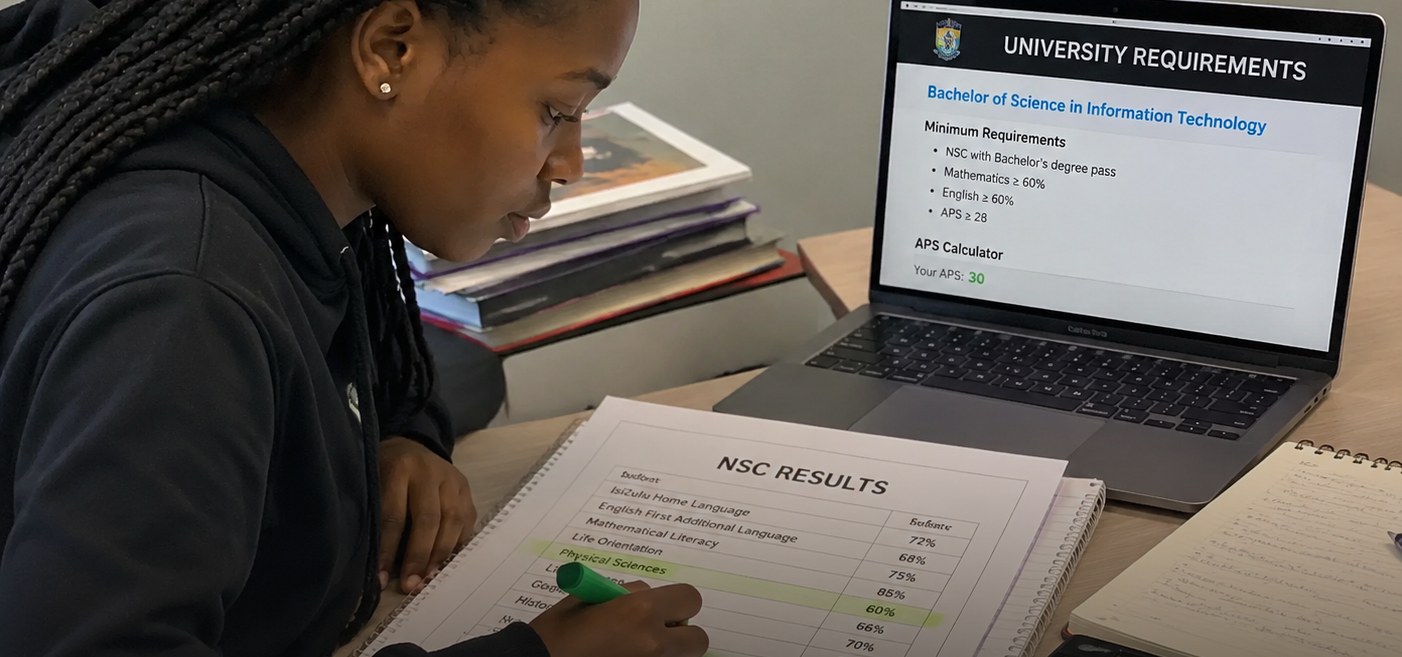
"Is my APS good?" is one of the most common questions learners ask once they've worked out their number — and it's also one of the hardest to answer generically, because a good APS is entirely relative to what you're applying for.
Why "good" depends on where you're applying
An APS of 28 might comfortably clear the minimum for a Diploma in Marketing at a university of technology, sit right on the line for a general BCom, and fall well short of a Bachelor of Medicine and Surgery, which can require 40+ alongside specific subject minimums. The same number means something different at every institution and every faculty.
Rough ranges you'll see (as a general guide only)
- 20–24 — often enough for higher certificates, some diplomas, and less competitive degree programmes.
- 25–29 — a solid range for many general Bachelor's degrees at most universities.
- 30–34 — competitive faculties: Engineering, Commerce at research-intensive universities, some Health Sciences streams.
- 35 and up — highly competitive programmes like Medicine, Actuarial Science, and flagship faculties at the most selective universities.
Treat these as a rough feel for the landscape, not a rulebook — always check the specific requirement for your specific programme at your specific university.
A high APS doesn't guarantee a spot
Meeting the minimum APS gets you considered, not accepted. Competitive programmes often rank applicants above the minimum using a separate points or selection process, so clearing the bar is the start of the process, not the end of it.
A lower APS isn't the end of the road
If your APS falls short of your first-choice degree, you still have real options: a related diploma that lets you transfer into the degree later, a foundation or bridging year designed to build you up to degree entry, or a TVET college qualification that leads into the same career a different way.
Not sure yet whether a degree, diploma or higher certificate is the better fit for your APS and goals? Here's the difference explained.